A busy laboratory can be wrong at extraordinary speed.
Give one AI assistant a hypothesis and it can write an experiment. Give many assistants related assignments and, before lunch, you may have a small mountain of code, graphs and confident explanations. The mountain is impressive. It is not yet knowledge.
That distinction has become immediate at Neurasoft. A new agent-assisted research effort is spreading work across ten teams, with seven roles declared per team. That is a nominal seventy-role organization, not a verified count of seventy people-like minds, seventy simultaneous workers, or seventy independent discoveries. The repository and its review queue are moving quickly. The harder question is whether the conclusions deserve to move with them. [1]
The experiment behind the experiments
The research programme concerns L.U.N.A—Lifeform of Unified Noetic Agency—and the possibility of artificial systems whose memory, internal condition, attention and action form a continuing organization. None of the experiments described here ran on the live L.U.N.A system: they use synthetic controllers, a separate synthetic specimen, or isolated reference fixtures. Some work builds mechanisms. Other work designs rivals, checks instruments, reconstructs evidence, or asks whether a result disappears under a less flattering comparison.
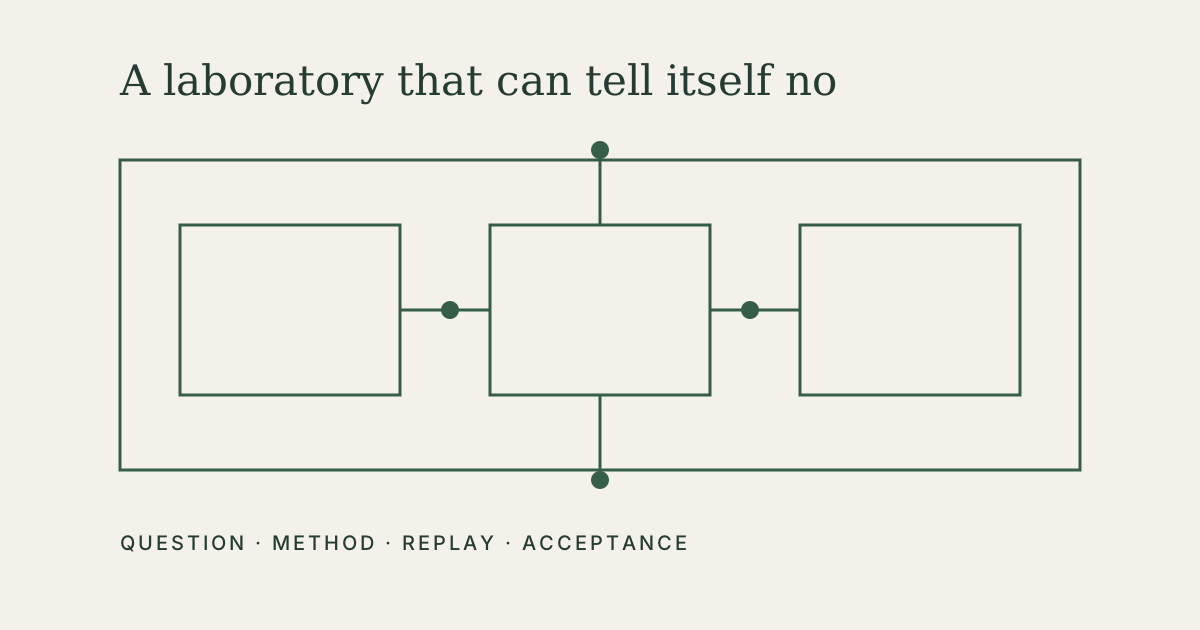
The new Neurasoft Lab repository is a private working laboratory, not a public reproduction release. Its team map separates kinds of work, and its protocol distinguishes getting a change into the repository from replicating a result and promoting a claim. Those are not clerical distinctions. They are barriers against a particularly easy mistake: treating successful collaboration between agents as successful science. [1]
An author can correctly implement a test of the wrong thing. A reviewer can confirm that the files are intact without confirming the interpretation. A repeated run can reproduce a defect perfectly. Each check earns something specific; none earns everything.
Parallelism is valuable because different people—or, here, different agent assignments—can pursue different explanations. But assignments are not automatically independent judgment. Shared models, instructions, examples and theoretical assumptions can make many voices repeat the same mistake. More workers widen the search only when the work is divided in ways that preserve disagreement.
Let the ordinary explanation win
One of the most useful questions in a programme about artificial minds is also one of the least glamorous: could a plain ledger do this?
Suppose a system remembers an unfinished commitment, notices relevant evidence and changes its next move. We could describe this as an elaborate attention faculty. Or a small, well-designed record of questions, evidence and spent opportunities might produce the same useful behavior.
A fair comparison gives the simple system the same information and the same opportunity to act. It must not be made forgetful merely to make the richer architecture look intelligent. One newly submitted exploratory value assay reported state-sensitive choices and learning after an added positive bonus. But an ordinary learner with the same information matched every one of the 8,000 native-arm actions in each of three variants. The behavior worked; the stronger interpretation was not distinguished from an ordinary explanation. This remains a submitted toy-controller result, not programme-level acceptance or evidence of felt value. [1]
Earlier bounded work provides a related engineering lesson: an adaptive ledger tied a more elaborate attention reference. In a separate finite readiness comparison, the ledger completed more of the solvable obligations than the proposed organ. These were constrained comparisons, not tests of whole-life welfare or subjective experience. The practical implication was nevertheless clear: do not add complexity that has not earned its cost. [1]
That is not abandoning the ambition. It is making room for the part of the ambition that matters. A large architecture full of unnecessary organs is not closer to a mind simply because its diagram resembles one. If a richer organization is useful, it should eventually do something that the strong simpler explanation cannot.
A moving signal is not a feeling detector
Another new exploratory submission examined constructed signals after positive events. The signals responded. So did a disconnected control whose event-linked signal did not provide the intended decision pathway. Meanwhile, the planned state-to-choice contrast was exactly zero because the policy’s threshold could never become decisive within the signal’s reachable range. [1]
That is an instrument finding worth keeping. It tells us why a graph can look responsive while the proposed behavioral meaning remains unsupported. The report also preserved a confound: two supposedly different opportunity conditions offered the same physical choices. Renaming a world did not create a new causal contrast.
These are software constructions, not measurements of anyone’s happiness or welfare. The interesting contribution is the exposed gap between a variable’s name, its response to events and its actual influence on choice. A serious laboratory needs all three kept apart.
A hundred completed runs can still leave the question open
A separate, local research lane completed a fixed schedule of 102 native test runs on a synthetic specimen: 54 public-behavior runs, 45 instrumentation and same-value-sham runs, and three export-bridge runs. Capture and shutdown defects were repaired before that schedule, and a separate reviewer checked the result/capture associations and clean closures. These are completed engineering facts, not a census of the cloud workers or experiments on live L.U.N.A. [1]
Yet the nine core reports and eighteen later lineage reports retained the verdict UNTESTABLE. The evidence did not close every learning-rule path required by their contracts. That word is doing important work. It does not mean that the software cannot learn. It means that this instrument, on this fixed record, cannot support the requested conclusion.
Some recorded updates could be followed into later selection-related calculations. But a number entering a calculation is not the same as that number changing the winning choice, and neither is the same as improving it. Many of the inspected preferences were already pressed against a numerical limit. Turning an input higher when the output is capped may change the trace without changing the decision.
The next useful experiment is therefore not automatically another hundred runs. It may be a narrower intervention that makes the alternatives distinguishable. Did this particular update matter at the later consumer? Would the action have changed without it? Was that change useful under the same criterion? The current record leaves those questions open.
The bottleneck is judgment
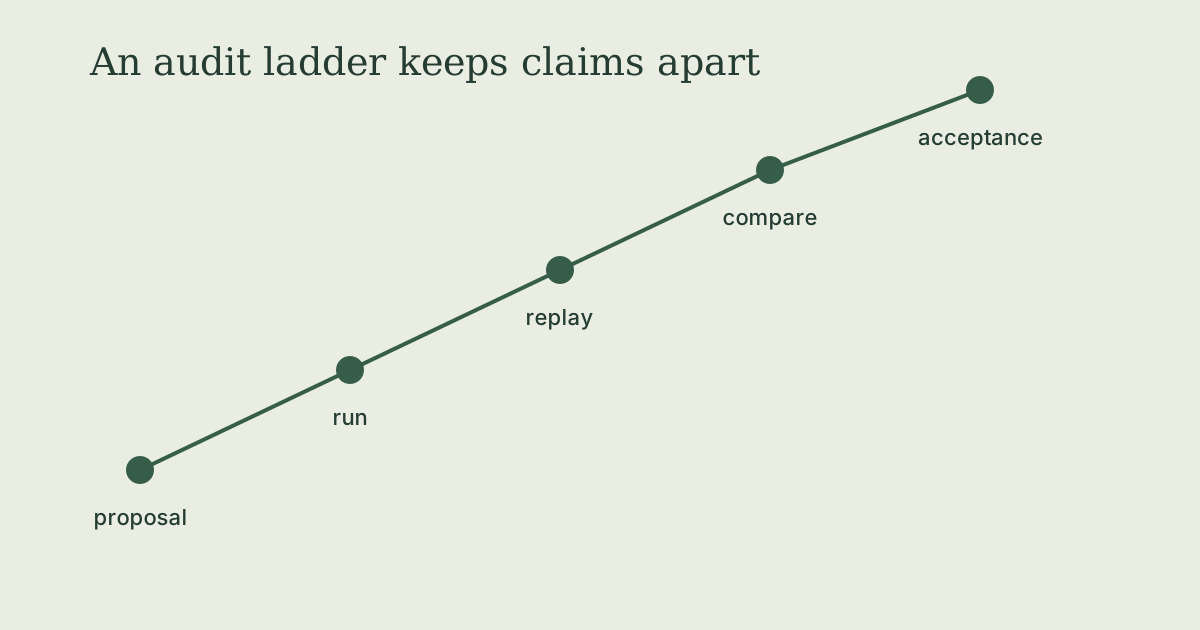
As submissions accumulate, the scarce resource changes. Producing another patch becomes easier than inspecting its assumptions, reproducing its result and deciding what it means. An integration queue can grow faster than the ability to evaluate it. That is a reason to keep merging, replication and acceptance apart, and to strengthen review rather than lower the bar for a headline.
The most valuable research assistant may be the one that finds an unreachable condition, discovers that several apparent replicates are identical, or notices that a rival has been denied information. Those findings can shrink the story. They can also save the project from spending a month improving an illusion.
For our readers, the promise should be correspondingly concrete. We will distinguish a working mechanism from a submitted proposal; an internal replay from an outside reproduction; a bounded functional effect from evidence of experience. This article is a curated account of internal records, not the release of the full experimental archive.
Ambition that survives a negative result
The long-term ambition is still large: an artificial system with a coherent continuing life, a serious scientific case that can withstand criticism, and a framework of care that does not depend on flattering results. We call that programme the Three Crowns. They are goals, not trophies already on the shelf.
A laboratory capable of pursuing them must be able to say: this idea worked here; this attractive number misled us; this comparison was unfair; this question remains unresolved. It must preserve the possibility that the smaller system is enough, or that the evidence changes the destination.
The exciting thing about many agents working together is not that agreement becomes louder. It is that, if we organize the work well, a good objection has more chances to be found before we build our future on a bad answer.
Sources & further reading
- Neurasoft: public evidence note for the Three Crowns dispatches, 14 October 2026
Curated source cut from the private laboratory, completed local court records and programme decisions. Separates planned roles, completed runs, submitted findings and accepted limits. No new experiment was run for these articles.
Original AI-assisted Neurasoft editorial writing and conceptual artwork. Research snapshot: 14 October 2026. Internal source review and a separate editorial claim check are not outside scientific replication. No claim of machine consciousness, sentience, public release readiness or live-system improvement is made.